
Kuripe Amethyst
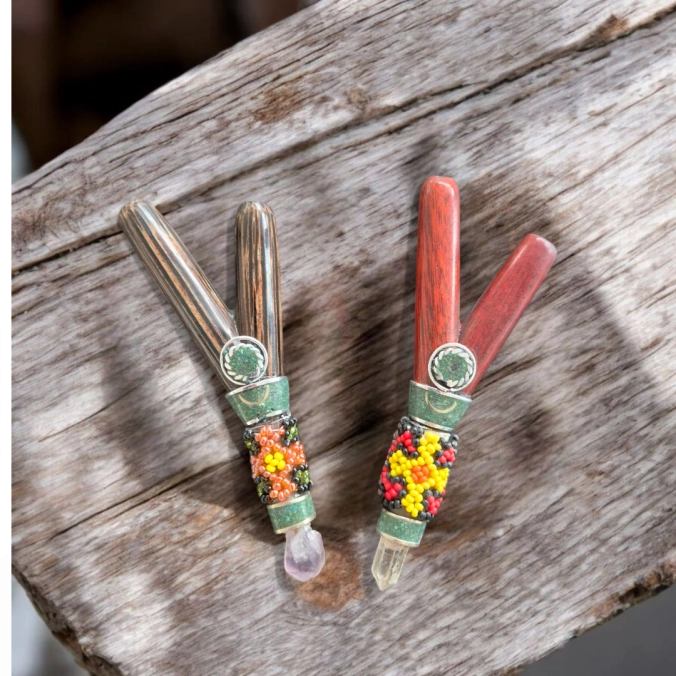
Handmade kuripe of about 12 cm, decorated with natural stones, including amethyst or white quartz, with turquoise accents and traditional bead ornamentation. It comes with an attached cord, so it can be carried easily. T...
Diskretes Paket
Neutraler, unbedruckter Karton
EU-Versand
Mit Tracking, 5–7 Werktage
Sichere Zahlung
PayPal, Karten, Überweisung
Nur für Erwachsene
Ab 18 Jahren
Kuripe Amethyst im Überblick
Die wichtigsten Fakten zu diesem Produkt.
Abgewinkelte Röhre
Die Röhre ist abgewinkelt, damit sich die Spitze bequem am Nasenloch ansetzen lässt.
Holz, Silber oder Stein
Gefertigt aus Holz wie Sawo, Teak oder Tamarinde oder aus Silber, teils mit Naturstein verziert. Das Material steht auf der jeweiligen Produktseite.
Tiermotive
Viele Applikatoren zeigen einen Tierkopf, etwa Jaguar, Adler, Wolf oder Kolibri. Das Motiv steht im Produkttitel.
Pflege
Wischen Sie den Applikator mit einem trockenen Tuch ab und halten Sie ihn von Wasser fern. Reinigen Sie ihn nicht mit Agua de Florida.
Technische Daten
Laut ProduktdatenChonta or Palo Sangre wood, amethyst or white quartz, turquoise, beads, cord
Laut Produktbeschreibung
Applikatorrohr
200101
Materialien
About 12 cm kuripe in Chonta or Palo Sangre wood, decorated with amethyst or white quartz, turquoise, beads and a cord.
- Chonta woodBlack or grey wood sold as 'Chonta'; in the Amazon the name is usually applied to palm wood.
Mehr zu diesem Material
'Chonta' is a common name in Peru and the wider Amazon for the hard, dark wood of certain palms, so botanical identification varies and the species is not stated. The product description gives the colour as black or grey.
- Palo Sangre woodRed-toned wood sold as 'Palo Sangre' (roughly 'blood wood'); the species is not stated in the product description.
Mehr zu diesem Material
'Palo Sangre' is Spanish for roughly 'blood wood' and is a common name for red-toned woods, so botanical identification varies and the species is not stated. The product description gives the colour as red and offers it as an alternative to Chonta. Some Tepi Shipibo texts write 'Palo Santo (red)'.
- AmethystAmethyst, the purple variety of quartz.
Mehr zu diesem Material
Amethyst is the purple variety of quartz (silicon dioxide), coloured by traces of iron in the crystal. The product description says the decoration on this kuripe is amethyst or white quartz, so the stone can differ between pieces.
- White quartzWhite quartz, a very common mineral (silicon dioxide), milky to translucent.
Mehr zu diesem Material
Quartz is silicon dioxide, one of the most common minerals in the Earth's crust. White or milky quartz is opaque to translucent. The product description lists it as the alternative to amethyst in the decoration of this kuripe.
- TurquoiseTurquoise, an opaque blue-to-green mineral used as a gemstone and in ornaments for thousands of years.
Mehr zu diesem Material
Turquoise is a hydrated copper aluminium phosphate mineral, opaque and blue to green in colour. It has been used in jewellery and ornaments in many cultures for thousands of years. The product description does not say whether the stones are untreated or stabilised.
- Beads (mostacilla)Small beads used as ornament; the product descriptions do not state what they are made of.
Mehr zu diesem Material
In Spanish, 'mostacilla' means small seed beads, which are typically glass and are widely used in Amazonian and Andean beadwork. The product description mentions only bead ornamentation and does not state what the beads are made of.
- CordA carrying or wearing cord; the product descriptions do not state its fibre.
Mehr zu diesem Material
The product description mentions a cord (in one case a black cord) but does not say what it is made of, so no fibre is claimed here.
Vollständige Produktbeschreibung
Die vollständige Beschreibung dieses Produkts und seiner traditionellen Verwendung.
Amethyst Kuripe is a beautifully crafted self-application tool designed for ceremonial use with hapé. This handmade amethyst kuripe measures approximately 12 cm and is decorated with natural stones, including amethyst or white quartz, complemented by turquoise accents and traditional bead ornamentation.
Available in Chonta (black/grey) and Palo Sangre (red) wood, each stone kuripe amethyst pipe combines durability with elegant craftsmanship. The attached cord makes this amethyst kuripe applicator convenient to carry during ceremonies, meditation, or personal rituals.
Sacred Tool for Hapé Practice
Used as a ceremonial amethyst kuripe, this tool allows precise self-application while maintaining focus during ritual work. Amethyst is traditionally associated with clarity and balance, making it a meaningful element in this amethyst kuripe rapé tool.
Many practitioners choose to buy amethyst kuripe as a functional and symbolic instrument for their practice. Carefully crafted and unique in design, this amethyst kuripe for hapé serves both as a practical ceremonial tool and a beautiful spiritual accessory.
Hinweis: Wird als ethnografische botanische Exemplare, Räucherharze und zeremonielle Artefakte geliefert. Es werden keine medizinischen oder therapeutischen Aussagen gemacht.
Über den Kuripe Amethyst
Der Amethyst-Kuripe ist ein handgefertigtes Röhrchen zur Selbstanwendung von Hapé, etwa 12 cm lang. Er ist mit Natursteinen verziert, darunter Amethyst oder weißer Quarz, mit Türkis-Akzenten und traditionellem Perlenschmuck.
Der Korpus besteht aus Chonta-Holz (schwarz/grau) oder Palo-Sangre-Holz (rot), und eine daran befestigte Schnur erleichtert das Mitnehmen zu Zeremonien, zur Meditation oder zu persönlichen Ritualen.
Ein Kuripe für die Hapé-Praxis
Als zeremonieller Amethyst-Kuripe verwendet, ermöglicht dieses Werkzeug eine präzise Selbstanwendung. Amethyst wird traditionell mit Klarheit und Ausgewogenheit verbunden, was ihn zu einem bedeutungsvollen Zierelement macht.
Viele Anwender kaufen einen Amethyst-Kuripe als funktionales und zugleich symbolisches Instrument. Holz, Steine und Perlen sind Naturmaterialien, daher variieren Farben und Zeichnung von Stück zu Stück.
Pflege Ihres Kuripe
Wischen Sie den Kuripe mit einem weichen Tuch ab und verwenden Sie für den inneren Schaft einen dünnen, trockenen Pfeifenreiniger. Legen Sie ihn nicht in Wasser, und reinigen Sie Tepi oder Kuripe nicht mit Agua de Florida.
Zeremonieller Audio-Begleiter
Hören Sie während Ihres Meditationsrituals sanfte schamanische Flötenklänge und heilige Dschungelgeräusche.
Amazonische Icaros & Flöte
Klanglandschaft für die Meditation
Empfohlenes Ritual & Vorbereitung
Einfache Hinweise, um Ihre Absicht zu würdigen und Ihre Praxis zu vertiefen.
Reinigen Sie Ihr Werkzeug
Räuchern Sie Ihren Applikator mit Palo Santo, um Restenergie zu klären.
Rapé abmessen
Geben Sie vorsichtig eine erbsengroße Menge Rapé-Pulver in die Röhre des Applikators.
Position ausrichten
Setzen Sie das lange Ende an den Mund und führen Sie die Spitze sanft und bequem in das Nasenloch ein.
Achtsamer Atemstoß
Blasen Sie ruhig und gleichmäßig. Schließen Sie die Augen und lassen Sie die erdende Energie wirken.
Häufig gestellte Fragen
Alles Wissenswerte zu Bestellung, Versand und Zahlung.
Wie wähle ich zwischen einem Kuripe (für sich selbst) und einem Tepi (für andere)?↓
Ein Kuripe ist V-förmig und dient dazu, Râpé bei sich selbst anzuwenden. Ein Tepi ist länger, damit ein Begleiter während der Zeremonie Râpé in die Nasenlöcher einer anderen Person blasen kann.
Wie reinige und desinfiziere ich Applikatoren aus Holz oder Silber?↓
Wischen Sie die Außenseite mit einem weichen Tuch ab. Reinigen Sie Tepi und Kuripe nicht mit Agua de Florida. Für die inneren Röhren verwenden Sie einen dünnen, trockenen Pfeifenreiniger. Tauchen Sie Holzgegenstände nicht in Wasser.
Welche Materialien werden verwendet?↓
Das Material jedes Applikators steht auf seiner Produktseite, zum Beispiel Sawo-, Tamarinden- oder Teakholz, Silber oder Naturstein.
Ist der Versand diskret?↓
Ja. Pakete werden in neutraler Verpackung ohne Hinweis auf den Inhalt verschickt, innerhalb der EU und mit Sendungsverfolgung.
Empfohlene Ergänzungen
Kuripe Amethyst
€49.95