
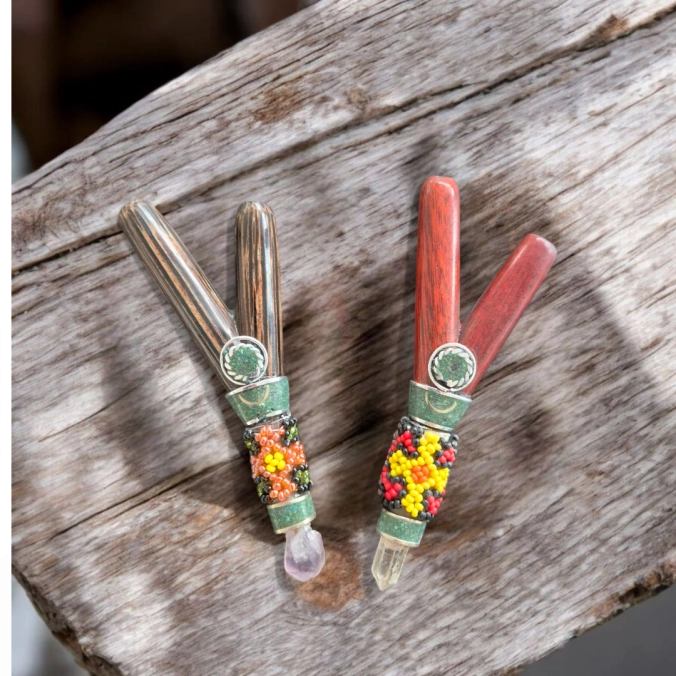
Kuripe Amethyst
Handmade kuripe of about 12 cm, decorated with natural stones, including amethyst or white quartz, with turquoise accents and traditional bead ornamentation. It comes with an attached cord, so it can be carried easily. T...
Paquete Discreto
Caja neutra, sin marca
Envío UE
Con seguimiento, 5-7 días laborables
Pago seguro
PayPal, tarjetas, transferencia
Solo para adultos
Mayores de 18 años
Kuripe Amethyst de un vistazo
Los datos principales de este producto.
Tubo en ángulo
El tubo está en ángulo para que la punta se apoye con comodidad en la fosa nasal.
Madera, plata o piedra
Fabricado en madera como Sawo, teca o tamarindo, o en plata, y a veces decorado con piedra natural. El material figura en la ficha de cada producto.
Motivos de animales
Muchos aplicadores muestran una cabeza de animal, como jaguar, águila, lobo o colibrí. El motivo figura en el título del producto.
Cuidado
Límpielo con un paño seco y manténgalo alejado del agua. No lo limpie con Agua de Florida.
Especificaciones técnicas
Según la ficha del productoChonta or Palo Sangre wood, amethyst or white quartz, turquoise, beads, cord
Según la descripción del producto
Tubo aplicador
200101
Materiales
About 12 cm kuripe in Chonta or Palo Sangre wood, decorated with amethyst or white quartz, turquoise, beads and a cord.
- Chonta woodBlack or grey wood sold as 'Chonta'; in the Amazon the name is usually applied to palm wood.
Más sobre este material
'Chonta' is a common name in Peru and the wider Amazon for the hard, dark wood of certain palms, so botanical identification varies and the species is not stated. The product description gives the colour as black or grey.
- Palo Sangre woodRed-toned wood sold as 'Palo Sangre' (roughly 'blood wood'); the species is not stated in the product description.
Más sobre este material
'Palo Sangre' is Spanish for roughly 'blood wood' and is a common name for red-toned woods, so botanical identification varies and the species is not stated. The product description gives the colour as red and offers it as an alternative to Chonta. Some Tepi Shipibo texts write 'Palo Santo (red)'.
- AmethystAmethyst, the purple variety of quartz.
Más sobre este material
Amethyst is the purple variety of quartz (silicon dioxide), coloured by traces of iron in the crystal. The product description says the decoration on this kuripe is amethyst or white quartz, so the stone can differ between pieces.
- White quartzWhite quartz, a very common mineral (silicon dioxide), milky to translucent.
Más sobre este material
Quartz is silicon dioxide, one of the most common minerals in the Earth's crust. White or milky quartz is opaque to translucent. The product description lists it as the alternative to amethyst in the decoration of this kuripe.
- TurquoiseTurquoise, an opaque blue-to-green mineral used as a gemstone and in ornaments for thousands of years.
Más sobre este material
Turquoise is a hydrated copper aluminium phosphate mineral, opaque and blue to green in colour. It has been used in jewellery and ornaments in many cultures for thousands of years. The product description does not say whether the stones are untreated or stabilised.
- Beads (mostacilla)Small beads used as ornament; the product descriptions do not state what they are made of.
Más sobre este material
In Spanish, 'mostacilla' means small seed beads, which are typically glass and are widely used in Amazonian and Andean beadwork. The product description mentions only bead ornamentation and does not state what the beads are made of.
- CordA carrying or wearing cord; the product descriptions do not state its fibre.
Más sobre este material
The product description mentions a cord (in one case a black cord) but does not say what it is made of, so no fibre is claimed here.
Descripción completa del producto
La descripción completa de este producto y de su uso tradicional.
Amethyst Kuripe is a beautifully crafted self-application tool designed for ceremonial use with hapé. This handmade amethyst kuripe measures approximately 12 cm and is decorated with natural stones, including amethyst or white quartz, complemented by turquoise accents and traditional bead ornamentation.
Available in Chonta (black/grey) and Palo Sangre (red) wood, each stone kuripe amethyst pipe combines durability with elegant craftsmanship. The attached cord makes this amethyst kuripe applicator convenient to carry during ceremonies, meditation, or personal rituals.
Sacred Tool for Hapé Practice
Used as a ceremonial amethyst kuripe, this tool allows precise self-application while maintaining focus during ritual work. Amethyst is traditionally associated with clarity and balance, making it a meaningful element in this amethyst kuripe rapé tool.
Many practitioners choose to buy amethyst kuripe as a functional and symbolic instrument for their practice. Carefully crafted and unique in design, this amethyst kuripe for hapé serves both as a practical ceremonial tool and a beautiful spiritual accessory.
Aviso: Se suministra como especímenes botánicos etnográficos, resinas de incienso y objetos ceremoniales. No se hacen afirmaciones médicas ni terapéuticas.
About the Kuripe Amethyst
The Amethyst Kuripe is a handmade self-application pipe for hapé, approximately 12 cm long. It is decorated with natural stones, including amethyst or white quartz, with turquoise accents and traditional bead ornamentation.
The body is made of Chonta (black/grey) or Palo Sangre (red) wood, and an attached cord makes it easy to carry to ceremonies, meditation or personal rituals.
A kuripe for hapé practice
Used as a ceremonial amethyst kuripe, this tool allows precise self-application. Amethyst is traditionally associated with clarity and balance, which makes it a meaningful decorative element.
Many practitioners buy an amethyst kuripe as both a functional and a symbolic instrument. Wood, stones and beads are natural materials, so colours and markings vary from piece to piece.
Caring for your kuripe
Wipe the kuripe with a soft cloth and use a thin, dry pipe cleaner for the inner barrel. Do not put it in water, and do not clean tepi or kuripe with Agua de Florida.
Compañero de audio ceremonial
Escucha una suave flauta chamánica y sonidos sagrados de la selva durante tu ritual de meditación.
Icaros amazónicos y flauta
Paisaje sonoro para meditar
Ritual y preparación sugeridos
Pautas sencillas para honrar tu intención y profundizar en tu práctica.
Purifica tu herramienta
Sahúma tu aplicador con Palo Santo para eliminar la energía residual.
Mida el rapé
Coloque con cuidado una cantidad de rapé del tamaño de un guisante en el tubo del aplicador.
Colócate correctamente
Lleva el extremo largo a tu boca e introduce suavemente la punta en la fosa nasal, con un contacto cómodo.
Soplido consciente
Sopla de forma tranquila y continua. Cierra los ojos e integra la energía de enraizamiento.
Preguntas frecuentes
Todo lo que necesita saber sobre el pedido, el envío y el pago.
¿Cómo elijo entre un Kuripe (para uno mismo) y un Tepi (para otra persona)?↓
El Kuripe tiene forma de V y sirve para aplicarse el Rapé a uno mismo. El Tepi es más largo para que un facilitador sople el Rapé en las fosas nasales de otra persona durante la ceremonia.
¿Cómo limpio y desinfecto los aplicadores de madera o plata?↓
Limpia el exterior con un paño suave. No limpies los tepi ni los kuripe con Agua de Florida. Para los tubos interiores, usa un limpiapipas fino y seco. Evita sumergir en agua los objetos de madera.
¿Qué materiales se utilizan?↓
El material de cada aplicador figura en su ficha de producto, por ejemplo madera de Sawo, tamarindo o teca, plata o piedra natural.
¿El envío es discreto?↓
Sí. Los paquetes se envían en un embalaje neutro, sin mención del contenido en el exterior, dentro de la UE y con seguimiento.
Combinaciones recomendadas
Kuripe Amethyst
€49.95